 In today’s digital world, social media has become an essential part of how businesses communicate with customers, promote products, build brands, and generate leads. From small businesses and startups to large companies, almost every brand uses social media to reach potential customers.
However, simply creating social media accounts and posting content is not enough. Businesses need a clear and structured social media promotion strategy to reach the right audience, create engaging content, increase visibility, and achieve measurable marketing goals.
A well-planned social media promotion strategy combines organic content, paid advertising, audience engagement, influencer collaborations, content marketing, and social media analytics. When these elements work together, businesses can create a strong online presence and turn social media followers into potential customers.
This complete guide explains what a social media promotion strategy is, why it is important, how to create one, which platforms to use, what types of content to publish, and how to measure your results.
What Is a Social Media Promotion Strategy?
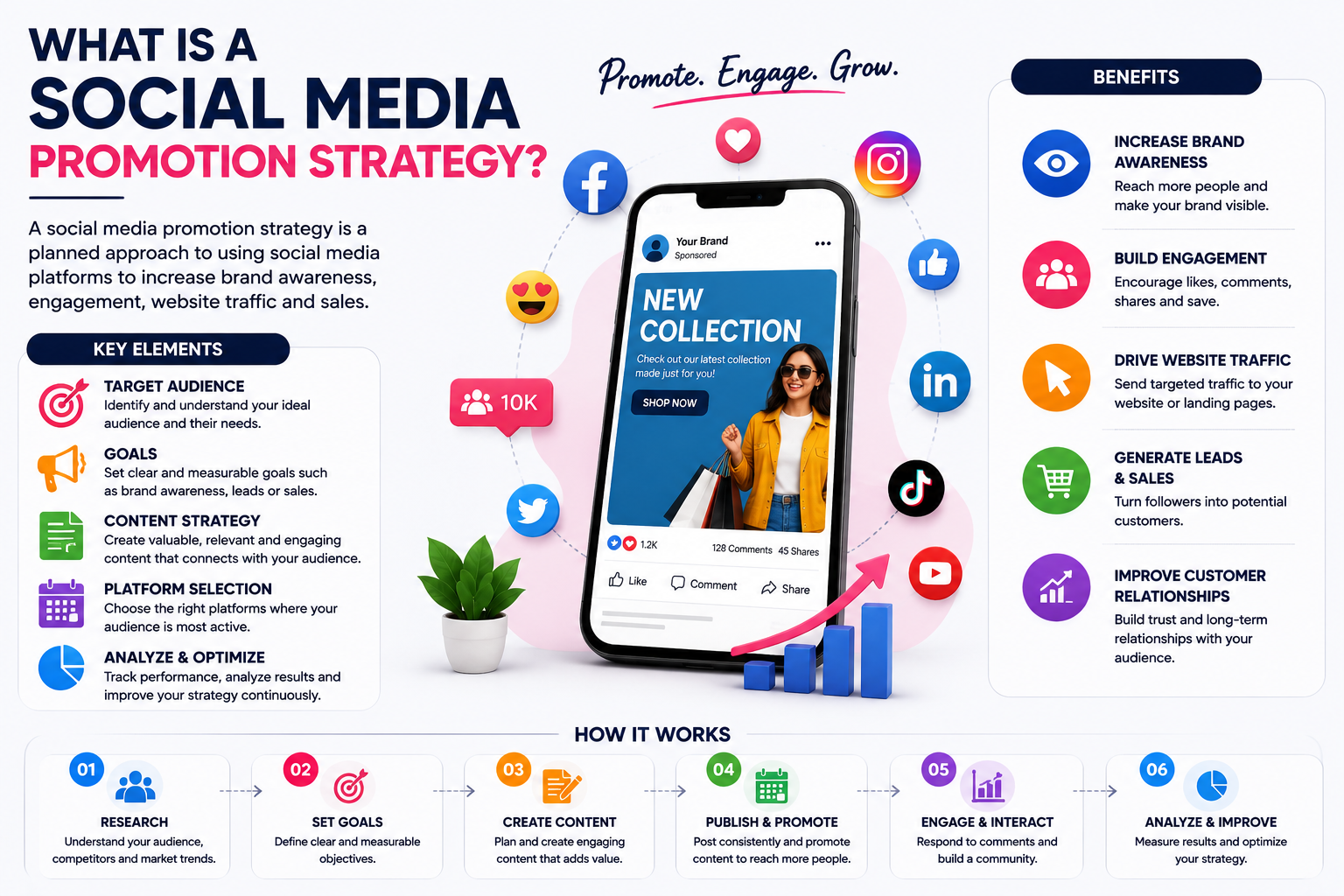
A social media promotion strategy is a planned method of using social media platforms to promote a brand, product, service, website, or content.
It involves deciding:
- Who your target audience is
- Which social media platforms to use
- What type of content to create
- When to publish content
- How to promote your content
- How to interact with your audience
- How to measure performance
- How to improve future campaigns
Unlike random posting, a strategic approach gives every social media activity a clear purpose.
For example, a business may use Instagram Reels to increase brand awareness, Facebook advertising to generate leads, LinkedIn content to reach professionals, and YouTube videos to educate potential customers.
The exact strategy depends on the business, industry, audience, budget, and marketing objectives.
Why Is a Social Media Promotion Strategy Important?
Social media provides businesses with an opportunity to communicate directly with their target audience. But without a strategy, businesses may spend time creating content without achieving meaningful results.
A strong social media promotion strategy helps businesses create consistency and direction.
1. Builds Brand Awareness
Social media allows businesses to introduce their brand to new audiences.
Consistent posts, videos, stories, and advertisements can help people recognize your brand and understand what your business offers.
Over time, repeated exposure can improve brand familiarity and visibility.
2. Reaches Your Target Audience
Social media platforms provide businesses with different ways to reach specific audiences.
Instead of trying to communicate with everyone, businesses can create content for particular customer groups based on their interests, needs, behaviors, and demographics.
3. Increases Engagement
Social media allows two-way communication between brands and customers.
Likes, comments, shares, saves, replies, and direct messages can create meaningful interactions between a business and its audience.
Higher-quality engagement can also provide valuable feedback about what customers want.
4. Generates Website Traffic
Social media can be used to direct users toward a business website, landing page, blog, online store, or contact form.
For example, a business can promote a blog article through LinkedIn, share a product page through Instagram, or use video content to encourage viewers to visit its website.
5. Supports Lead Generation
Social media can become an important source of leads.
Businesses can use educational content, lead forms, landing pages, offers, webinars, and direct messages to encourage potential customers to take action.
6. Helps Build Customer Relationships
Social media is not only a promotional channel. It is also a communication platform.
Responding to comments and messages, answering questions, and providing useful information can help businesses build stronger relationships with their audience.
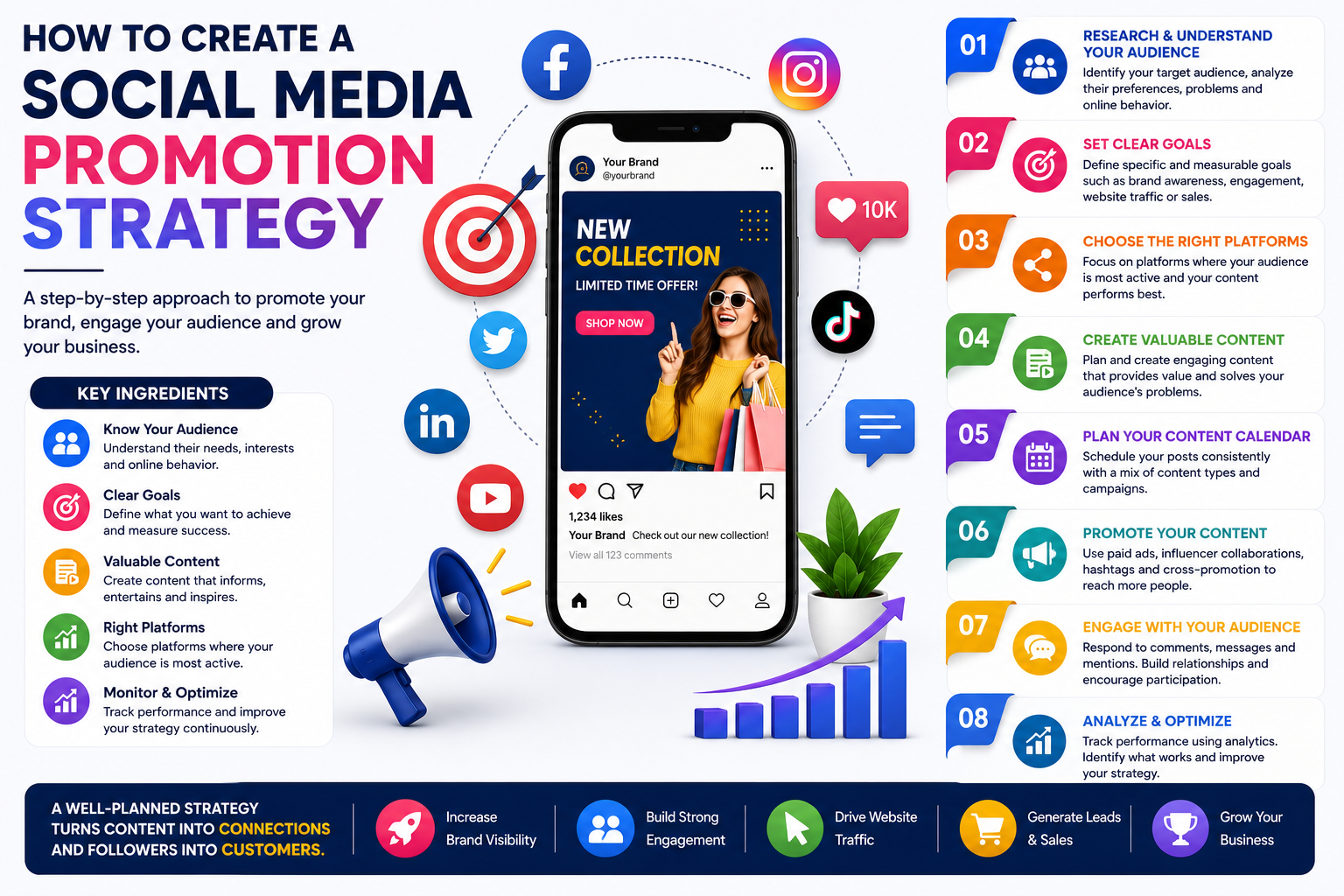
How to Create a Social Media Promotion Strategy
Creating an effective strategy requires planning. The following steps can help businesses develop a structured approach.
Step 1: Define Your Social Media Goals
Before creating content, decide what you want to achieve.
Your goals should be specific and measurable.
Common social media goals include:
- Increase brand awareness
- Increase followers
- Improve engagement
- Generate leads
- Increase website traffic
- Promote products
- Increase sales
- Build an online community
- Improve customer relationships
- Establish industry authority
For example, instead of saying “I want more followers,” a business could set a goal of increasing relevant followers by a specific percentage over a defined period.
Clear goals make it easier to evaluate performance.
Step 2: Identify Your Target Audience
Understanding your target audience is one of the most important parts of a social media promotion strategy.
You should understand who your ideal customer is and what they need.
Consider:
- Age
- Location
- Interests
- Profession
- Purchasing behavior
- Problems
- Goals
- Preferred content
- Favorite social media platforms
For example, a fashion brand targeting young customers may focus heavily on visual content and short-form videos, while a B2B software company may focus more on LinkedIn and educational content.
The better you understand your audience, the easier it becomes to create relevant content.
Step 3: Research Your Competitors
Competitor analysis can provide useful information for developing your social media strategy.
Look at:
- Which platforms competitors use
- How frequently they post
- Which content formats they use
- Which posts receive high engagement
- What topics they discuss
- How they communicate with customers
- What types of advertisements they use
Competitor research should not mean copying another brand.
Instead, identify opportunities to differentiate your business and provide something more useful or unique.
Step 4: Choose the Right Social Media Platforms
You do not necessarily need to use every social media platform.
The best platform depends on your target audience and business objectives.
Instagram is highly visual and can be useful for:
- Reels
- Stories
- Product promotion
- Brand awareness
- Influencer marketing
- Visual storytelling
- Community engagement
Facebook can be useful for:
- Community building
- Business pages
- Video content
- Advertising
- Local businesses
- Customer communication
LinkedIn is particularly useful for professional and B2B marketing.
Businesses can use it for:
- Thought leadership
- Industry content
- Professional networking
- Recruitment
- B2B lead generation
- Company updates
YouTube
YouTube is useful for video-based marketing.
Businesses can create:
- Tutorials
- Product demonstrations
- Educational videos
- Reviews
- Interviews
- How-to videos
- Long-form content
- Shorts
TikTok
Short-form video platforms can help brands reach audiences through entertaining, educational, and trend-based content.
The key is to select platforms based on where your audience is active rather than trying to maintain every possible account.
Step 5: Develop Your Content Strategy
Content is the foundation of a successful social media promotion strategy.
A content strategy determines what you will publish and why.
One useful approach is to create different content pillars.
Educational Content
Educational content helps your audience learn something useful.
Examples include:
- Tips
- Tutorials
- Guides
- Industry information
- How-to videos
- Frequently asked questions
Entertaining Content
Entertainment can help increase engagement and make your brand more relatable.
Examples include:
- Short videos
- Memes
- Trends
- Challenges
- Behind-the-scenes content
Promotional Content
Promotional content directly highlights your products or services.
Examples include:
- Product launches
- Discounts
- Special offers
- New services
- Product demonstrations
Inspirational Content
Inspirational content can create an emotional connection with your audience.
Examples include:
- Customer success stories
- Business journeys
- Motivational messages
- Brand stories
User-Generated Content
User-generated content, commonly called UGC, is content created by customers or users.
Examples include:
- Customer reviews
- Testimonials
- Product photos
- Customer videos
- Social media mentions
UGC can provide social proof and help potential customers understand how others interact with a brand.
Step 6: Create a Social Media Content Calendar
Consistency is important in social media marketing.
A content calendar helps you plan posts in advance instead of deciding what to publish at the last minute.
A simple content calendar can include:
Day | Content Type | Platform | Topic | Goal |
Monday | Educational | Marketing Tip | Engagement | |
Tuesday | Reel | Quick Tutorial | Reach | |
Wednesday | Article | Industry Topic | Authority | |
Thursday | Product Post | Product Feature | Promotion | |
Friday | Video | YouTube | How-To Guide | Traffic |
Saturday | Story | Behind the Scenes | Engagement |
A content calendar also helps maintain a consistent brand voice and visual identity.
Step 7: Create Engaging Social Media Content
Creating content is not enough. Your content needs to capture attention and provide value.
Use Strong Hooks
The first few seconds of a video or the first line of a post can determine whether someone continues reading or watching.
Examples of hooks include:
- “Are you making these social media mistakes?”
- “Here are five ways to improve your online presence.”
- “Before you run your next ad campaign, read this.”
- “Want more engagement on Instagram?”
Use Visual Content
Images, videos, carousels, infographics, and other visual formats can make information easier to understand.
Tell Stories
Storytelling can make your content more memorable.
Instead of only describing a product, explain the problem it solves, the journey behind it, or how customers use it.
Add a Call to Action
A call to action, or CTA, tells the audience what to do next.
Examples include:
- Learn more
- Visit our website
- Follow us
- Share this post
- Save this post
- Contact us
- Download the guide
- Shop now
Step 8: Use Organic Social Media Promotion
Organic promotion refers to activities that do not rely directly on paid advertising.
Examples include:
- Regular posts
- Reels
- Stories
- Hashtags
- Community engagement
- Comments
- Shares
- User-generated content
- Collaborations
Organic social media marketing can help businesses build long-term relationships with their audience.
However, organic reach can vary depending on the platform, content quality, audience behavior, and algorithm.
Step 9: Use Paid Social Media Advertising
Paid promotion can complement organic social media marketing.
Businesses can create advertisements designed for objectives such as:
- Brand awareness
- Website traffic
- Engagement
- Lead generation
- Product promotion
- Conversions
Paid campaigns can also be tested with different audiences, creative formats, and messages.
For example, a business might test two different ad designs to determine which one generates more clicks or leads.
The important thing is to set a clear objective before spending money.
Step 10: Develop a Hashtag Strategy
Hashtags can help categorize and discover social media content on platforms that support them.
A useful hashtag strategy should focus on relevance.
You can consider:
- Industry hashtags
- Brand hashtags
- Product hashtags
- Location-based hashtags
- Campaign hashtags
- Niche hashtags
Avoid adding unrelated hashtags simply because they are popular.
The goal is to attract people who are actually interested in your content.
Step 11: Use Influencer Marketing
Influencer marketing can be another component of a social media promotion strategy.
Businesses can collaborate with creators who have an audience that matches their target market.
Potential collaborations include:
- Product reviews
- Sponsored posts
- Product demonstrations
- Unboxing videos
- Giveaways
- Brand partnerships
The most important factor is relevance.
An influencer with a smaller but highly relevant audience may be more valuable than someone with a very large audience that has little connection to your product.
Step 12: Engage With Your Audience
Social media should be treated as a conversation rather than a broadcasting channel.
Respond to:
- Comments
- Questions
- Direct messages
- Mentions
- Reviews
- Feedback
Engagement demonstrates that the business is paying attention to its customers.
It can also help businesses discover common questions and turn them into future content ideas.
Step 13: Maintain a Consistent Brand Identity
Your social media profiles should have a recognizable identity.
Consistency can include:
- Brand colors
- Fonts
- Logo usage
- Photography style
- Graphic design
- Writing style
- Tone of voice
For example, a luxury brand may use a sophisticated communication style, while a youth-focused brand may use a more casual and energetic tone.
A consistent identity makes your content easier to recognize.
Step 14: Use Social Media Trends Carefully
Social media trends can provide opportunities to increase reach.
These may include:
- Trending audio
- Video formats
- Challenges
- Popular topics
- New content features
However, businesses should not follow every trend.
A trend should fit your brand and audience. Forced or irrelevant trends can make content appear unnatural.
Step 15: Measure Social Media Performance
One of the most important parts of a social media promotion strategy is measuring results.
Important social media metrics include:
Reach
Reach indicates how many users were exposed to your content.
Impressions
Impressions represent the number of times content was displayed.
Engagement Rate
Engagement rate helps measure interactions such as likes, comments, shares, and saves relative to the audience or reach.
Click-Through Rate
CTR measures how often people click on a link or advertisement after seeing it.
Follower Growth
Follower growth shows how your audience size changes over time.
Conversion Rate
Conversion rate measures the percentage of users who complete a desired action.
Return on Investment
ROI helps businesses understand whether their marketing investment is producing worthwhile results.
Social Media Promotion Strategy for Small Businesses
 Small businesses often have limited budgets and resources.
A practical approach is to focus on a few platforms instead of trying to manage everything.
Start with:
- Identifying the target audience
- Choosing one or two relevant platforms
- Creating useful content
- Maintaining consistency
- Engaging with followers
- Testing small paid campaigns
- Tracking results
Small businesses can also use local content, customer testimonials, behind-the-scenes posts, and educational videos to build trust.
Social Media Promotion Strategy for Startups
Startups can use social media to introduce their brand and build an initial community.
A startup strategy may include:
- Brand storytelling
- Founder content
- Educational content
- Product demonstrations
- Customer testimonials
- Short-form videos
- Influencer collaborations
- Community engagement
- Paid advertising
Building trust is especially important for new businesses because potential customers may not be familiar with the brand.
Common Social Media Promotion Mistakes
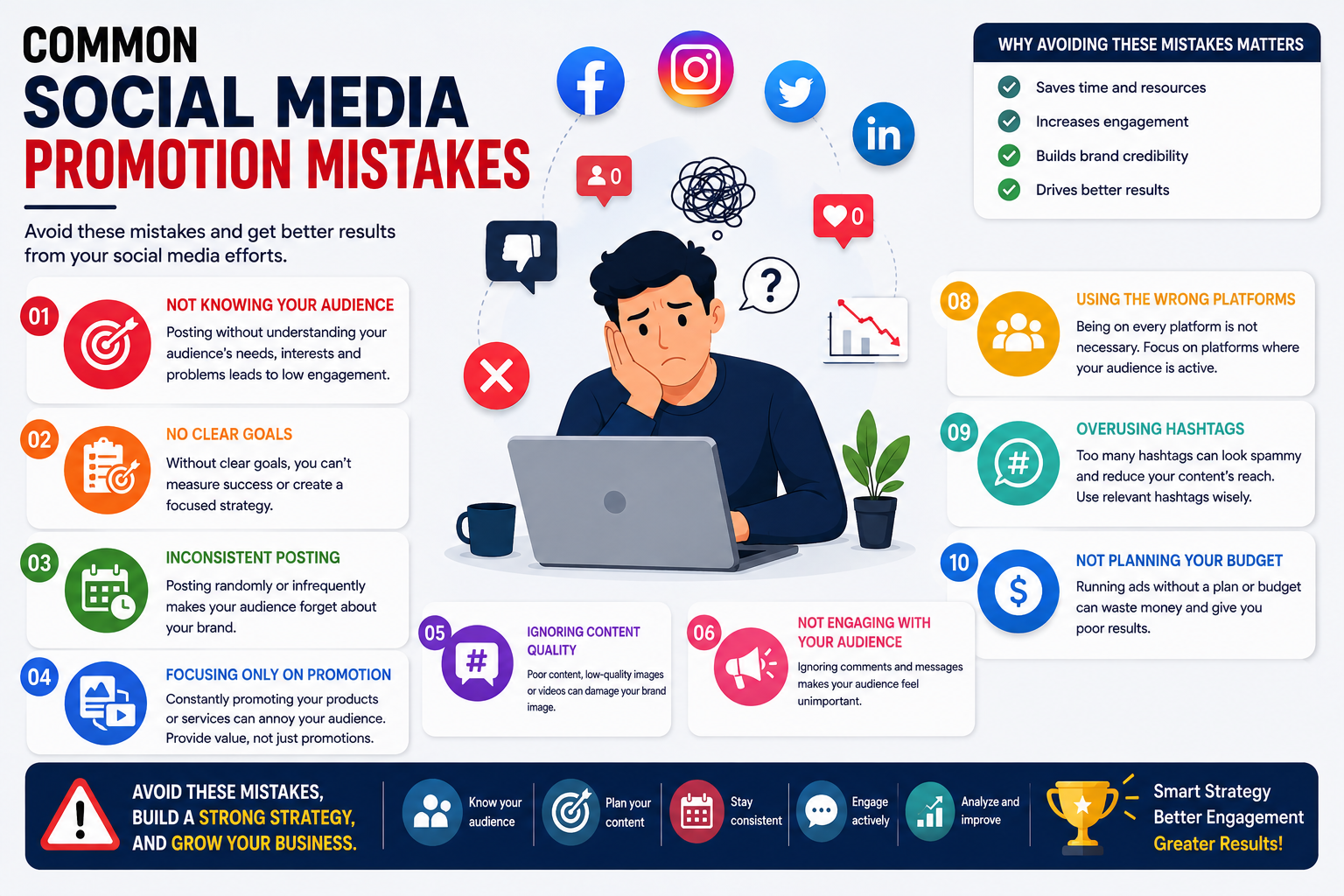 Even businesses with good products can struggle on social media because of poor strategy.
1. Posting Without a Plan
Random content can make a social media account inconsistent.
2. Focusing Only on Sales
Constant promotional posts can reduce audience interest.
Try to balance promotional content with educational, entertaining, and valuable content.
3. Ignoring Comments
Ignoring customers can make the brand appear unresponsive.
4. Using Every Platform
Managing too many platforms can reduce content quality.
5. Not Tracking Results
Without analytics, it is difficult to understand what is working.
6. Copying Competitors
Competitor research is useful, but copying their content can prevent your brand from developing its own identity.
7. Ignoring the Audience
A strategy should be based on audience needs rather than only what the business wants to promote.
How to Improve Your Social Media Promotion Strategy
A social media strategy should continuously evolve.
You can improve your approach by:
- Reviewing analytics regularly
- Identifying high-performing content
- Reusing successful content in new formats
- Testing different hooks
- Experimenting with posting times
- Testing different CTAs
- Understanding audience feedback
- Following relevant trends
- Improving visual quality
- Updating your content calendar
Instead of changing everything at once, test one element at a time when possible. This makes it easier to understand what caused an improvement or decline in performance.
Future of Social Media Promotion
Social media marketing continues to evolve as platforms introduce new features and audiences change their content preferences.
Short-form video, creator partnerships, social commerce, personalized content, community-based marketing, and AI-assisted content creation are becoming increasingly important areas for marketers to understand.
Businesses that continuously learn, test, and adapt are better positioned to respond to changes in the social media environment.
The future of social media promotion is not simply about gaining followers. It is increasingly about building meaningful relationships, creating useful experiences, and connecting content with measurable business outcomes.
Conclusion
A successful social media promotion strategy requires much more than regularly publishing posts. It involves understanding your audience, setting clear goals, selecting the right platforms, creating valuable content, engaging with your community, using paid promotion strategically, and analyzing performance.
Whether you are a small business, startup, personal brand, creator, or established company, social media can become a powerful part of your digital marketing strategy when it is approached with proper planning.
The key is to focus on the right audience, provide consistent value, maintain a recognizable brand identity, measure your results, and continuously improve your strategy.
With the right social media promotion strategy, businesses can increase brand awareness, strengthen customer relationships, generate leads, drive website traffic, and build a sustainable presence in the digital marketplace.
Author Sabith